For most of the last two decades, going out for a real dinner in Dogpatch meant a plan that started with leaving Dogpatch. You could get a great pizza at Long Bridge, a lasagna the size of a hubcap at Marcella's, or a plate of Gujarati small plates at Ungrafted. What you couldn't get was a tasting menu, a reason to dress up, or a table you'd book weeks out. For that, you crossed the city.
That changed last October, and the neighborhood has spent the months since figuring out what to do with it.
The Meal That Used to Require Leaving
Wolfsbane opened at 2495 Third Street in mid-October 2025, in the space that used to house Serpentine. The team behind it is the same trio that ran Lord Stanley on Russian Hill until 2024: Rupert and Carrie Blease, joined by Tommy Halvorson, who owned Serpentine itself before it closed in 2020. In June 2026, Wolfsbane earned a Michelin star, less than a year after opening.
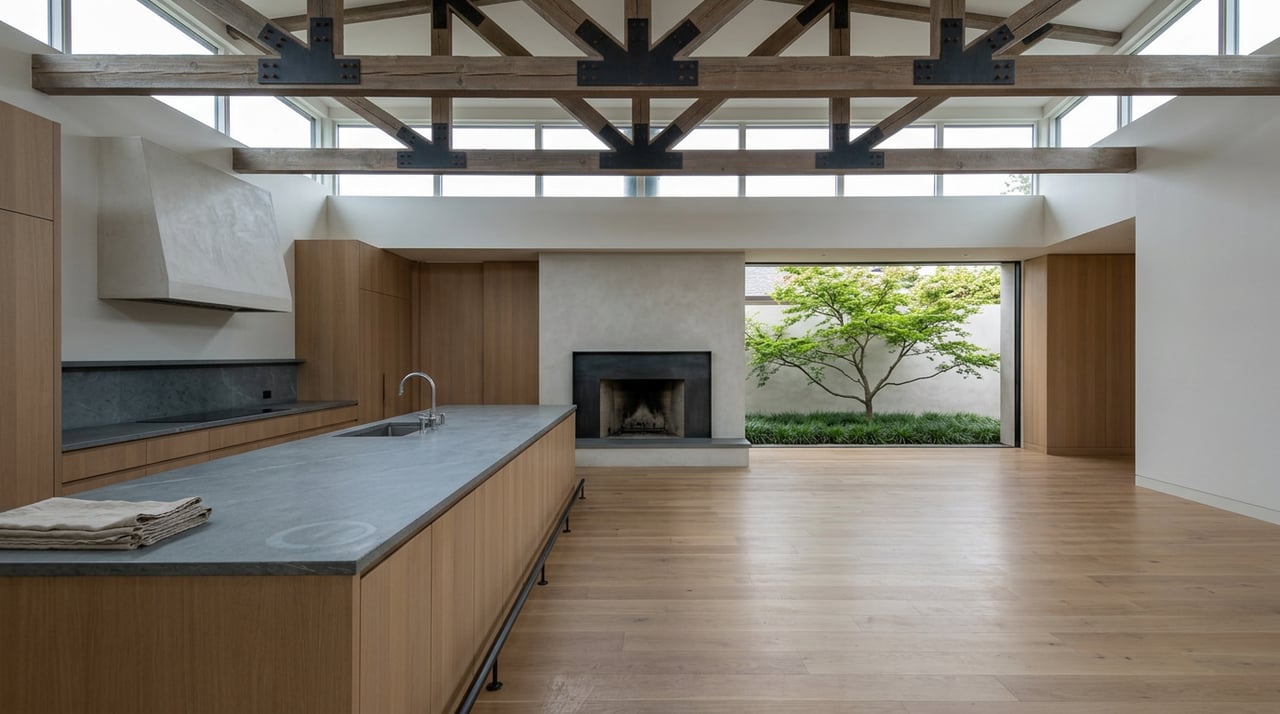
The details matter here because they tell you what kind of restaurant this actually is. A tasting menu at Wolfsbane runs into the hundreds of dollars per person, and a dinner for two with wine and service can push past a thousand dollars. That's not a neighborhood restaurant price point. It's a special-occasion price point, delivered by chefs with Per Se and Le Manoir aux Quat'Saisons on their résumés, in a room built from a former factory boiler room with soaring ceilings and exposed pipe. The San Francisco Chronicle's restaurant critic reviewed it as one of the strongest openings of the year. The pastry program alone has drawn separate praise.
None of that would matter to someone who already lives in Dogpatch if it were just another good restaurant a mile from home. What makes it worth writing about is that Dogpatch has never had this register of dining before. Wikipedia's own entry on the restaurant notes it as one of the first true fine-dining rooms the neighborhood has seen, arriving in a place still known mostly for casual eateries. That's not a marketing line. It's a structural fact about what existed here and what didn't.
Not a Replacement, an Addition
Here's the part that's easy to get wrong: none of this happened because the old Dogpatch got pushed out. Moshi Moshi, the sushi spot that's been a neighborhood fixture since 1987 and holds San Francisco Legacy Business status, is still slinging sake flights. Marcella's Lasagneria is still open for lunch only, with a line out the door on Saturdays like it's had for years. Piccino still does its farm-to-table thing with a covered parklet out front. Long Bridge Pizza still bakes sourdough pies that lean on tang over char.
What Wolfsbane's star did was add a category, not swap one out. If you wanted counter-service breakfast burritos before, you still have Bandit. If you wanted a whiskey-forward cocktail with jerky pairings, Third Rail is still pouring. The neighborhood's casual backbone held. It just stopped being the only option.
That distinction matters if you live here and you're trying to figure out what actually changed on your block. It's not that Dogpatch got fancier. It's that Dogpatch got a second gear it didn't have before, sitting right alongside the first one.
The Rest of the Weekend Got Built Around It
The restaurant story doesn't happen in isolation. It landed in a neighborhood that had just finished assembling the rest of a full day out.
Esprit Park reopened in February 2025 after a two-year, $8.5 million renovation, split between a north meadow for off-leash dogs and a south meadow that's dog-free by design. The project was funded in part by a $5 million contribution from UCSF, and it replaced a park that had become, by most residents' accounts, more useful to dogs than to people. One longtime Dogpatch resident, quoted at the reopening after 28 years in the neighborhood, said the renovation "elevates Dogpatch to an actual bona fide neighborhood." That's a strong claim from someone who'd avoided the old park entirely, and it says something about how thin the neighborhood's public gathering space had been until recently.
A few blocks toward the water, Crane Cove Park has quietly become the daytime counterpart to all this. Dogpatch Paddle, a kayak and paddleboard outfit that started as a community club when the park opened in 2020, now counts around 700 members and runs lessons out of the park's protected cove. Between the paddle club, the park meadows, and the galleries at Minnesota Street Project a few blocks inland, a Saturday in Dogpatch can now run from a morning on the water to an afternoon looking at art to a dinner reservation, all without getting in a car.
What a Friday Actually Looks Like Now
If you're mapping this onto an actual evening, the mechanics are worth knowing. Wolfsbane only opens bookings on the 15th of each month for roughly the following two months, and reservations at that price point don't sit open for long. It's open Tuesday through Saturday, seating starts at 5:30, and the room is split into three distinct spaces: an 18-seat main dining room, a 20-person private area called The Den, and a six-seat booth space called The Burrow. That structure means Wolfsbane can absorb a big group and a quiet two-top on the same night without either feeling like an afterthought.
A few blocks away, the neighborhood keeps expanding in the other direction too. Pier 70's redevelopment has brought in a second location of Standard Deviant Brewing and the bakery Breadbelly, both feeding into the same stretch of Third Street that already runs from Souvla's Greek wine and mezze bar to the RH showroom and restaurant that opened in a former steel-company building. None of that is fine dining, but all of it is new inventory for a corridor that, five years ago, was mostly warehouses and light industry.
The net effect for someone who's lived here through the shift is that the neighborhood stopped requiring a choice. You don't have to pick between staying local and having a real night out. You don't have to pick between a dog-friendly park and a quiet one. Esprit Park reopened in February 2025 and Wolfsbane opened eight months later, which means both sides of that equation got built inside the same year, and most of it happened quietly enough that you'd only notice if you were paying attention to your own block.
The Part That's Still Worth Watching
None of this means Dogpatch has finished changing. The Esprit Park renovation took roughly six years from initial community planning to ribbon-cutting, with delays stacking up over tree removal, drainage work, and contractor disputes along the way. Wolfsbane's star is barely three months old as of this writing, and Michelin stars have a way of reshuffling a neighborhood's dining gravity in ways that take a few years to settle. The population here grew by more than 200 percent between 2010 and 2020, according to Chronicle reporting on the Esprit Park project, and that kind of growth curve doesn't level off just because a park finished construction.
What's true right now, in September 2026, is that the version of Dogpatch you'd describe to a friend has changed in a specific and checkable way. It's not vaguer language about an up-and-coming neighborhood. It's a Michelin star that didn't exist here a year ago, a park that finally works for the people who live around it, and a paddle club with 700 members using a cove that was underwater industrial land not that long ago. That's not atmosphere. That's a neighborhood doing something it genuinely couldn't do a year and a half ago.
If you're watching how a neighborhood like this translates into home values, or you're curious what a shift like this means if you're thinking about buying or selling nearby, Aviva Kamler tracks these changes as part of representing San Francisco buyers and sellers day to day. Request a Personalized Home Valuation to talk through what's happening on your specific block.